Thursday, May 19, 2011

Josephine, Claire & Pamela

Swamped. Underwater. Drowning in purses.

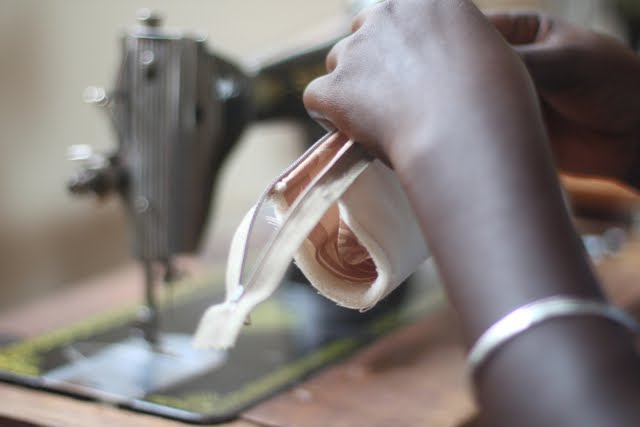
In fall 2009, after Stacey Edgar visited our project, we received our largest handbag order to date. We knew we were going to need more tailors to get things done. We'd brought all of our tailors under one roof in June 2009, but the ladies from Bobi and Unyama camps weren't quite ready to make our more complicated purse designs to the level of quality we needed. One day after work, Lucy and I were talking about our predicament, discussing our options.

The next morning was a rainy one, and I knew Gulu would be in a standstill. With most people traveling on foot or by bicycle, very little happens on rainy weekday mornings. I took my time waking up, made some coffee and unlocked the workshop door. I was headed to the office with my laptop bag, but out of the corner of my eye I saw three ladies huddled on the front porch.

Aol Josephine. Lajaro Claire. Akello Pamela.

Lajaro Claire lounges on the front porch with one of Aber Grace's daughters

All three women were wrapped in woolen scarves, shivering in the cool Gulu rain. Pamela and Josephine were nursing their babies. I smiled and greeted them all, and quickly realized that none of them spoke English. I had no idea why they were there. Suddenly my phone rang - it was Prisca. She apologized for being late to work (Prisca rides her bicycle several miles to get to work each day), and asked if any of the ladies had yet arrived. I glanced at the three women on the porch - they avoided my eyes.

Aol Josephine's adorable Jonathon

"Um, yes, there are three ladies I've never met - none of them speak English. I think they've been sitting on our porch for some time. Do you know anything about this?" I asked.

"Ahhh, sorry," Prisca laughed her short, now famous laugh. "Those must be the new ladies Lucy found - they are already tailors and they can sew well - they can help us with our order. I am coming Halle, let me come."

Pamela, Josephine and Claire would come to be a steady force within One Mango Tree. After just a few days of work, it was as if they'd always been with us. They made fast friends with the other women, and set an example with their punctuality, concentration, and consistent quality of work. Pamela's daughter Maria was terrified of mzungus (white people), and screamed bloody murder anytime I came near her. I enjoyed her cuteness from afar - Pamela always beaded her hair and tied a teddy bear to her back in the same way women carry their babies in Uganda. Eventually her fear dissipated, and she even started to shake my hand.

Pamela comforting Maria after a mzungu encounter

Josephine brought Jonathon to work every day, in a comfy cocoon on her back, swaddled with a piece of cloth. He quietly looked around the room, rarely making a peep, and always content for a nap after his feedings.

Josephine working with sleeping Jonathon on her back

This was all before Alice, our daycare teacher, and Maria is now in nursery school full time. Adong Kevin's daughter, Aber Juliet, has taken over the sassy "mzungus-are-going-to-eat-me" role. When I was in Gulu last month, Josephine and Claire were both pregnant, and getting close to their delivery dates - both the perfect picture of healthy mothers.

When I was looking through photos to use for the new blog design, one of Claire and Josephine - back when they first started with us and were working away diligently on that huge order - seemed the perfect choice.

Check out this great photo of Josephine, Claire and Pamela in traditional Acholi dress.

Photos in this post were taken by Crystaline Randazzo during her time at One Mango Tree with Momenta Workshops.

xo Halle

Tuesday, May 17, 2011

Adventures in sourcing: horn & leather

Cross-posted from OMT Founder Halle Butvin's personal blog, Locus Amoenus

Sourcing locally is a big deal for us in Uganda.
I certainly appreciate the meaning of value-add - particularly in a country where so many resources are exported raw (coffee, tobacco, tea, cotton, to name a few). Our organic apparel line at One Mango Tree boasts "seed-to-sewn," but it's at a high cost. There is only one factory transforming Uganda's organic cotton crop into knit. High school economics taught me that only one company equals a monopoly, and we're learning - the hard way - all about the impacts on pricing. Pricing issues aside, the factory doesn't have the flexibility to mix in Lycra, or to produce heathered textures. We do what we can with what we have.

factory visit with our print manufacturer, july 2010

Another reason we try to keep supply chains in Uganda is because of logistics. Uganda is land-locked, so for us, the only way to import findings (zippers, buttons, rings, etc.) is using costly air freight to bring them in. We buy zips for our bags in the local markets, but the trusty YKK brand is not available in Uganda. We often have to sacrifice quality by buying in the local market.

adding a local market zipper to a coin purse in production

As we work on design improvements on our products, naturally the conversation falls to trims - small additions we can make to the bags that add a lot of value. Horn and leather are two items in Uganda that have a lot of market potential, so Gihan and I went on a little adventure to find both.

Horn

The horn guy wasn't too difficult to find - after all there's only one of him. All of the horn bowls, napkin rings, bracelets and rings in the local markets are made by one company. On a gray, rainy afternoon we drove out to visit Charles at his workshop. We pulled in to a water-logged field, the mud sucking our shoes as we stepped out of the Pajero. Charles invited us into his office, which was in a wooden building that had been lifted up onto cinder block stilts. I expected to see the striped stockings of the Wicked Witch of the West peeking out from the foundation. We walked down a creaking, tilted hallway and into the main office, where Charles explained the set up.

"You see, the government came in and improved the roundabout here," he gestured towards the road outside.

"Most people are happy about that. But I own this land, and when they build the new road, they elevated it. Now all the runoff comes right into my lands. Every time it rains, even a little, our workshops flood and people cannot work."

We weren't able to see the workshop that day, and learned that flooding is seriously hurting the business. Weather isn't his only problem. When we asked about high prices, Charles explained that the Chinese are coming in and buying up all the horn.

"I have a relationship with the butchers here. I've been working with them for many, many years," he explained.

"I used to go to trade shows in China to sell our horn products. Now the Chinese come and buy the horn straight from the butchers - by the CONTAINER! - and take it back to China to process it themselves. And," he paused, widening his eyes, "do you know that they are undercutting my prices?! They have increased the cost of horn for me here in Uganda, and they can still make the products cheaper than I can."

Gihan and I exchanged glances. This was becoming a familiar problem. Uganda's companies all seemed to be capital poor. While natural resources were abundant, they often found that they couldn't match the prices paid by foreign buyers. As a result, raw goods flew right out of the country before Ugandan companies could add value. We faced this all the time with Phenix, our organic cotton knit producer. With a worldwide cotton shortage, the Chinese, South Koreans and others had come in to Uganda and bought up all the raw organic cotton. Instead of buying knit from Phenix, they were taking it back and processing it themselves - and then selling the final knit version cheaper than the Ugandans could. We were left with the little Phenix could produce, which came with a very high price tag to make up for these losses.

We left Charles with some sample pieces for some horn jewelry we wanted to try, and picked our way through the marshy property back to the car.

Leather

Cows are a big deal in Uganda, so you might think leather goods would be a home run. Or that we could at least find some leather goods in Uganda. Or maybe just Ugandan leather. Our leads led us to a residential area off Ggaba Road, where we found what turned out to be a mid-size shoe factory. The scale of production was impressive - someone had clearly invested a lot of money into this project, judging by the heavy machinery that was being used to make work boots, sandals and all sorts of shoes for the local market. A friend suggested that they might sell us some leather to use for bag trims.

In the marketing office, the staff pulled out rolls and rolls of soft leather dyed in pastel colors. We marveled at the flexibility - it would work very well as piping and trim on bags. Gihan asked about the origins of the leather.

"Oh, this one? It is goat. From the UK. Very good quality. How much you want to buy?"

In a country FULL of cows and butcher shops, they were trying to sell us pastel British goat leather. The only Ugandan leather they had was extremely thick black leather used for uppers on work boots. Finally Joseph, our contact and the Director, came in from an outside meeting. After a brief conversation about our needs, he sent us off to a company called Fishnet, and we assured him that we'd be back if we ever got into the business of shoe-making.

Continuing on our journey, we headed back across the city into industrial area, to a compound not five minutes from our own apparel workshop. I'd heard that Fishnet sold leather, but Gihan was insistent that they only sold nets for catching fish. I enjoyed giving him a hard time about the huge detour we made with the shoe factory visit, when the leather place was our neighbor.

We walked into the main building, the facade tiled with undersea scenes. The reception area was empty. Gihan peered over the counter and waved me over excitedly. It was 330 in the afternoon, and the receptionist was sleeping. Not at her desk, but on an actual mattress next to her desk. She had a pillow and blanket, and was clearly sound asleep. We had to suppress our giggles as we walked down the hallway to find someone conscious to help us out.

I found a woman in the first doorway, labeled "Marketing Department," and walked into her office. I asked if we could find the person in charge of selling leather samples. She rolled her eyes dramatically and gestured to a chair outside her office. There was a one foot by one foot hole cut into the wall adjacent to her desk, with a chair sitting next to it. Apparently the protocol was that information could only be shared through the "window." Once I was in the chair, she perked up -

"Yes, hello. Welcome to Fishnet. How can I help you?" as if I hadn't met her just a second before.

I played along "Yes, thank you so much. We are looking for the person here who sells leather." Gihan stood in the hallway suppressing his laughter at me talking through this literal hole-in-the-wall.

After much back and forth, we found ourselves in a small room lined with shelves - shelves stacked high with high-quality, Ugandan leather. We bought a hide and drove the few minutes back to our workshop, content to add two more materials to our list of Ugandan-sourced supplies:

Organic cotton knit
Woven cotton prints
Banana leaf
Seeds
Horn (could be made into buttons, toggles, loops/rings, etc.)
Leather (could be made into straps, trims, or whole bags)

xo Halle

Thursday, May 5, 2011

May Giveaway: Signed copy of Global Girlfriend!

Friends! Our May giveaway is here, and we're so excited to share it with you. Global Girlfriends is the story of how Stacey Edgar started the biggest fair trade business in America from a $2,000 tax return and a passion to help women. Stacey's story introduces you to women artisans all over the globe (India, Nepal, Uganda!), and shows how powerful change can occur when women buy fair trade, women-made products.


Global Girlfriends is a very important story for One Mango Tree - we met Stacey in August 2009 when she came out to Uganda to visit One Mango Tree - chapter 11 is all about Stacey's visit, and the subsequent work we've done together, starting up our 100% organic cotton knit apparel line with her generous support and guidance. It's our link with Global Girlfriend that has taken One Mango Tree products into Whole Foods, Target.com and fair trade boutiques across the US.

Stacey was sweet enough to give us a signed copy of her book. Since you (our customers) are the ones who drive the success of ventures like One Mango Tree and Global Girlfriend, we want to give that copy to you!

To win the signed copy of Global Girlfriends, help us spread the word about One Mango Tree, our newest products, and what we’re up to. Just mention us on Twitter, Facebook, or in your blog (and then send it to us) so we can enter you in for the running to win a free book! If you just can’t wait, in high hopes of winning it, order it now and let us know what you think!


Summer 2011 Lookbook

Check out some images of our new Summer 2011 Collection, with gorgeous photography by Lauranne and modeling done by Ashlee, a volunteer at Invisible Children in San Diego. Enjoy!

Tuesday, May 3, 2011

Hello Summer

Okay, so spring was apparently a bit of a drag on the East Coast. I heard it's been raining in Columbus, Ohio, for four straight weeks... but as they say "April showers bring..." I missed out on all the cruddy cold weather - I was in Uganda, and lucky enough to watch the dry earth come to life as rainy season showed its face (in Uganda, we rejoice when it rains). We were busy working on One Mango Tree's Summer 2011 collection, and it's here - available for pre-order now!


What does pre-order mean? You order and pay now (take advantage of free shipping May 3 & 4), and you'll get these awesome new products as soon as the shipment touches down in the USA - we expect to start shipping May 11-12. The horrible riots that have been going on in Uganda these past few weeks delayed our shipment - we were unable to get downtown to the Ministry of Tourism and Industry, which is where we pick up the paperwork needed to ensure our apparel shipment is duty-free (under the African Growth and Opportunities Act, or AGOA).

We're expecting the order to ship any day now, so go ahead and get your hands on these amazing new bags, skirts (yes, those adorable tribal skirts) and Party Dresses in three new colors!

'Things We Love' Fridays: Tribal Prints!!!

So, lucky for YOU – guess what the number one style across the boards by everyone from Free People to Nordstrom is right now? That’s right, you guessed it, TRIBAL PRINTS! We’re so excited about our soon-to-be-released Spring Collection – bursting with color, patterns, and a strong ethnic feel.

Check out these beautiful prints from designers such as Marc by Marc Jacobs, Tracy Reese, and Dries Van Noten from one of our favorite style blogs, Fashionandotherstuff.com.


As stated by the socialvixen.com: Primal and tribal print is a spring summer 2010 trend that “dances to the beat of a tribal drum with modern, African-inspired pieces.” Almost every designer includes some exotic influences in their spring summer 2010 collection.


And lastly, one of our favorite stores LF’s ode to Native Prints, endorsing tribal influences and fearless fashionistas.


Get ready to see new releases by One Mango Tree - bags, clutches, and aprons, as well as a new line of incredibly colorful skirts, shirts, and dresses. Pre-order launches this week!

Happy Mother's Day!

At One Mango Tree, work and mothering are often one and the same. Alice does her best to care for the smallest kiddos, but moms will pop in and out of the workshop to feed their babies and give them some love and attention. Just like moms the world over, the One Mango Tree tailors put their children first, doing everything they can to keep food on the table and school fees paid.

Betty chases naked little Obama, who escaped after his bath

Lawill Margret holds Ogen Rwot Alex, just after feeding him lunch

Anena Betty and Obama, her youngest

We know that moms all over the world work so hard to see their children thrive and succeed. We're spending this week honoring the One Mango Tree ladies, and of course thinking of our own moms and everything they've done to make us who we are. Are you ready for Mother's Day?

We're going to sweeten the deal and give you FREE SHIPPING on orders of $30 of more - you have two days to take advantage of this offer (ends midnight May 4th) before Mother's Day. Get your mom a token of appreciation - and there's no better way than to support the moms at One Mango Tree!

LinkWithin

Related Posts with Thumbnails